
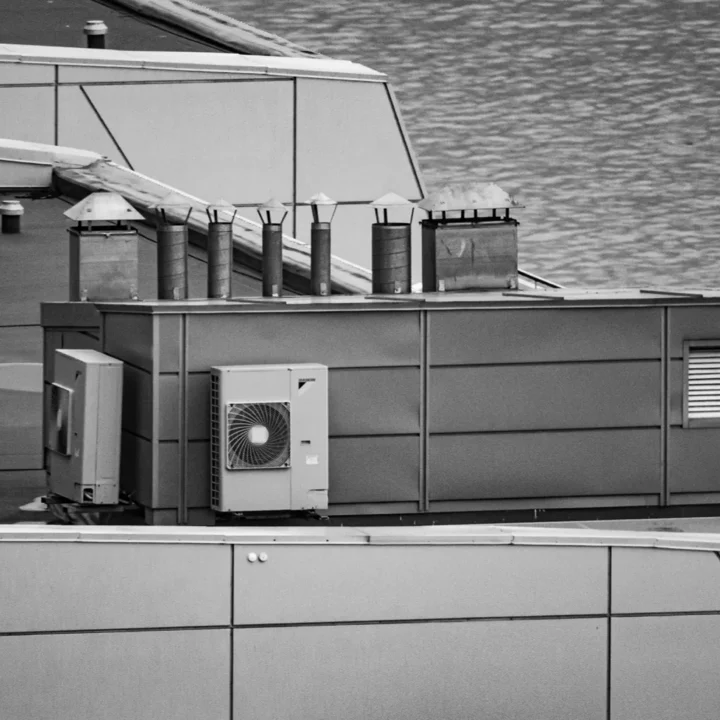
A rooftop unit, or RTU, is a packaged HVAC system that sits on the roof of a building and handles heating, cooling and ventilation from a single cabinet. The compressor, condenser coil, evaporator coil, supply fan and usually a gas furnace or heat pump are all built in. Conditioned air goes down into the building through supply ductwork, and return air comes back up to the unit.
RTUs are the most common HVAC equipment on low-rise commercial buildings: retail stores, restaurants, schools, warehouses, offices and strip malls. For HVAC distributors, they are also among the highest value items on a quote, so getting the RTU takeoff right matters.
What is inside a rooftop unit
- Compressor(s): pump refrigerant through the cooling circuit. Larger units have multiple compressors or variable-speed compressors for better part-load efficiency.
- Condenser coil and fans: reject heat to the outdoors.
- Evaporator coil: cools and dehumidifies the supply air.
- Supply fan (blower): moves air through the ductwork. Many units now use direct-drive ECM or variable-speed fans.
- Heat section: a gas heat exchanger, an electric heater, or a reversing valve for heat pump operation.
- Economizer (optional): dampers that use outdoor air for "free cooling" when conditions allow.
- Filters and controls: a filter rack and a unit controller, often with a building automation interface.
Types of rooftop units
Gas/electric. The most common type. Electric cooling with a gas-fired heat section. Popular where natural gas is available and affordable.
Heat pump. Runs the refrigeration cycle in reverse to heat, often with electric backup heat. Growing quickly as owners and codes push toward electrification.
Electric heat. Electric cooling with resistance heat strips. Simple, but expensive to run in cold climates.
DOAS rooftop units. Dedicated outdoor air units that condition 100 percent outdoor air for ventilation, often paired with VRF or other zone equipment.
Constant volume vs VAV RTUs. Smaller RTUs usually serve one zone. Larger RTUs can be built for VAV operation, serving many VAV boxes downstream. Single-zone VAV units vary fan speed to match the load of one zone.
RTU sizes
RTU cooling capacity is measured in tons. One ton equals 12,000 Btu per hour of cooling.
- Light commercial: roughly 3 to 25 tons. Most retail, restaurant and small office jobs land here.
- Large commercial: roughly 25 tons and up, with custom and semi-custom units going well above 100 tons.
Heating capacity is listed in MBH (thousand Btu per hour), usually as both input and output for gas units.
Common manufacturers include Carrier, Trane, Lennox, York, Daikin, AAON and Rheem. The schedule names one as the basis of design, and the specs list the approved equals.
How to read an RTU schedule
The RTU schedule is where the takeoff really happens. It is one of the equipment schedules in the mechanical set, and a typical one includes:
- Tag: RTU-1, RTU-2 and so on, matched to the roof plan
- Manufacturer and model: the basis of design
- Nominal tons: cooling size
- Total and sensible capacity: cooling output in MBH at design conditions
- Supply CFM and ESP: airflow and external static pressure
- Outdoor air CFM: minimum ventilation air
- Heating: gas input and output MBH, electric kW, or heat pump capacity
- Efficiency: rated efficiency, for example IEER or SEER2
- Electrical: voltage, phase, MCA and MOP
- Refrigerant: refrigerant type
- Weight: operating weight, for structure and rigging
- Accessories and remarks: curb, economizer, smoke detector and more
Pay attention to the refrigerant column. New packaged units now ship with lower-GWP refrigerants such as R-454B or R-32 under the EPA's refrigerant transition. Older specs or reused schedules may still list R-410A, which is worth an RFI.
The accessories estimators miss
On RTU quotes, the unit itself is rarely where you lose money. It is the accessories. Check the schedule remarks, general notes and specs for:
- Roof curb, and the curb height, often 14 or 24 inches
- Curb adapter on replacement jobs where the new unit's footprint differs from the old one
- Economizer and the type of economizer control required
- Power exhaust or barometric relief
- Supply or return smoke detectors
- Hail guards on the condenser coil
- Factory-mounted disconnect and convenience outlet
- Low ambient kit for cooling in cold weather
- Communication card, BACnet or similar, for the building automation system
- Extended warranties on compressors or heat exchangers
Any one of these can be required by a single line in the spec. Missing it means either eating the cost or going back to the contractor with a change.
Quoting RTUs as a distributor
A few things change how you price RTUs:
Replacement vs new construction. Most branch RTU business is replacement. Replacement quotes depend on matching the existing curb, electrical service and gas connection. New construction quotes come from plans and specs.
Basis of design vs approved equal. If the basis of design is a competitor's brand, your quote is a substitution. Match capacity, airflow, electrical, weight and dimensions closely, and confirm the curb will work.
Lead times. Larger and custom units can have long lead times. Put the expected ship date on the quote. Contractors often choose the supplier who can deliver on schedule.
Weight. Heavier substitutes may need a structural review. Note weight differences on substitutions.
Common RTU takeoff mistakes
- Counting RTUs from the schedule without checking the roof plan for quantities
- Missing units shown only on a phasing or demolition plan
- Missing curbs or curb adapters
- Pricing standard efficiency when the spec requires high efficiency
- Ignoring the remarks column
- Quoting from the original set after an addendum changed tonnage
Get RTU schedules into a quote faster
Monaro finds the RTU schedule in your drawing set, pulls each unit's capacity, electrical data and accessories, and counts every tag on the roof plan. Your team reviews the result and builds the quote in a fraction of the time it takes to do it by hand. That is what automated HVAC takeoff software is for: the counting is mechanical work, and the judgement is not.
Frequently asked questions
What is an RTU in HVAC? An RTU is a rooftop unit: a packaged HVAC system on the roof that provides heating, cooling and ventilation from one cabinet.
How long do rooftop units last? A well-maintained rooftop unit commonly lasts around 15 to 20 years, depending on climate, run hours and maintenance.
What size rooftop unit do I need? Sizing comes from a load calculation done by the engineer. As a rough guide, light commercial RTUs range from about 3 to 25 tons.
What is the difference between an RTU and an AHU? An RTU is a self-contained packaged unit with its own refrigeration. An air handling unit moves and conditions air but usually relies on a separate chiller, boiler or condensing unit.
What is a roof curb? A roof curb is the frame the RTU sits on. It supports the unit, seals the roof opening and connects to the supply and return ductwork.
See it on your own RTU job
Try Monaro free on your next RTU job. No credit card required.
